Tuesday, August 16, 2011

The Downgrade


Earlier this week my brother-in-law shared with me excerpts from the book Ashamed of the Gospel by John MacArthur.  MacArthur addressed a series of articles published in 1887 by Charles Spurgeon in his monthly magazine, The Sword and the Trowel.  The articles, published under the title The Downgrade, suggested that the church was “going down hill at breakneck speed” and as the down hill plunge continued the evangelicals sought compromise to maintain  peace and unity.

It is almost uncanny how relevant what Spurgeon wrote in 1887 is to the church in 2011.  So without any additional commentary (for those who find this sort of thing as fascinating as I do) here’s a bit (actually a lot) of what Spurgeon (and his close friend Robert Shindler) had to say to the church then and today:

The downward slide usually began slowly, almost imperceptibly. [D]enominations often "got on the down-grade" when they abandoned Calvinism (which emphasizes God's sovereignty in salvation) in favor of Arminianism (which makes human will the decisive factor). Other groups embraced Arianism (which denies the full deity of Christ). Still others simply became enamored with scholarship and worldly wisdom; consequently they lost their zeal for truth.

The Presbyterians were the first to get on the down line. They took the route of worldly wisdom: They paid more attention to classical attainments and other branches of learning. . . . It [was therefore] an easy step in the wrong direction to pay increased attention to academical attainments in their ministers, and less to spiritual qualifications; and to set a higher value on scholarship and oratory, than on evangelical zeal and ability to rightly divide the word of truth.

As is usual with people on an incline, some who got on "the down grade" went further than they intended, showing that it is easier to get on than to get off, and that where there is no brake it is very difficult to stop. Those who turned from Calvinism may not have dreamed of denying the proper deity of the Son of God, renouncing faith in his atoning death and justifying righteousness, and denouncing the doctrine of human depravity, the need of Divine renewal, and the necessity for the Holy Spirit's gracious work, in order that men might become new creatures; but, dreaming or not dreaming, this result became a reality.

These men deepened their own condemnation, and promoted the everlasting ruin of many of their followers by their hypocrisy and deceit; professing to be the ambassadors of Christ, and the heralds of his glorious gospel, their aim was to ignore his claims, deny him his rights, lower his character, rend the glorious vesture of his salvation, and trample his crown in the dust.

 Many of those who remained true to the faith were nevertheless reluctant to fight for what they believed in. Evangelical preaching was often cold and lifeless, and even those who held to sound doctrine were careless about where they drew the line in their associations with others: "Those who were really orthodox in their sentiments were too often lax and unfaithful as to the introduction of heretical ministers into their pulpits, either as assistants or occasional preachers. In this way the Arian and Socinian heresies were introduced into the Presbyterian congregations…

The first step astray is a want of adequate faith in the divine inspiration of the sacred Scriptures. All the while a man bows to the authority of God's Word, he will not entertain any sentiment contrary to its teaching. "To the law and to the testimony," is his appeal concerning every doctrine. He esteems that holy Book, concerning all things, to be right, and therefore he hates every false way. But let a man question, or entertain low views of the inspiration and authority of the Bible, and he is without chart to guide him, and without anchor to hold him.

 Our solemn conviction is that things are much worse in many churches than they seem to be, and are rapidly tending downward. Read those newspapers which represent the Broad School of Dissent, and ask yourself, How much farther could they go? What doctrine remains to be abandoned? What other truth to be the object of contempt? A new religion has been initiated, which is no more Christianity than chalk is cheese; and this religion, being destitute of moral honesty, palms itself off as the old faith with slight improvements, and on this plea usurps pulpits which were erected for gospel preaching.

It now becomes a serious question how far those who abide by the faith once delivered to the saints should fraternize with those who have turned aside to another gospel. Christian love has its claims, and divisions are to be shunned as grievous evils; but how far are we justified in being in confederacy with those who are departing from the truth? It is a difficult question to answer so as to keep the balance of the duties. For the present it behooves believers to be cautious, lest they lend their support and countenance to the betrayers of the Lord. It is one thing to overleap all boundaries of denominational restriction for the truth's sake: this we hope all godly men will do more and more. It is quite another policy which would urge us to subordinate the maintenance of truth to denominational prosperity and unity. Numbers of easy-minded people wink at error so long as it is committed by a clever man and a good-natured brother, who has so many fine points about him. Let each believer judge for himself; but, for our part, we have put on a few fresh bolts to our door, and we have given orders to keep the chain up; for, under colour of begging the friendship of the servant, there are those about who aim at robbing the Master.

We fear it is hopeless ever to form a society which can keep out men base enough to profess one thing and believe another; but it might be possible to make an informal alliance among all who hold the Christianity of their fathers. Little as they might be able to do, they could at least protest, and as far as possible free themselves of that complicity which will be involved in a conspiracy of silence.

The house is being robbed, its very walls are being digged down, but the good people who are in bed are too fond of the warmth, and too much afraid of getting broken heads, to go downstairs and meet the burglars; they are even half vexed that a certain noisy fellow will spring his rattle, or cry, 'Thieves!'

The divergence is every day becoming more manifest. A chasm is opening between the men who believe their Bibles and the men who are prepared for an advance upon Scripture. Inspiration and speculation cannot long abide in peace. Compromise there can be none. We cannot hold the inspiration of the Word, and yet reject it; we cannot believe in the atonement and deny it; we cannot hold the doctrine of the fall and yet talk of the evolution of spiritual life from human nature; we cannot recognise the punishment of the impenitent and yet indulge the "larger hope." One way or the other we must go. Decision is the virtue of the hour. Neither when we have chosen our way can we keep company with those who go the other way.

Let those who will keep the narrow way keep it, and suffer for their choice; but to hope to follow the broad road at the same time is an absurdity. What communion hath Christ with Belial?

Thus far we come, and pause. Let us, as many as are of one mind, wait upon the Lord to know what Israel ought to do. With steadfast faith let us take our places; not in anger, not in the spirit of suspicion or division, but in watchfulness and resolve. Let us not pretend to a fellowship which we do not feel, nor hide convictions which are burning in our hearts. The times are perilous, and the responsibility of every individual believer is a burden which he must bear, or prove a traitor. What each man's place and course should be the Lord will make clear unto him.

What action is to be taken we leave to those who can see more plainly than we do what Israel ought to do. One thing is clear to us: we cannot be expected to meet in any Union which comprehends those whose teaching is upon fundamental points exactly the reverse of that which we hold dear. . . . To us it appears that there are many things upon which compromise is possible, but there are others in which it would be an act of treason to pretend to fellowship. With deep regret we abstain from assembling with those whom we dearly love and heartily respect, since it would involve us in a confederacy with those with whom we can have no communion in the Lord.

During the past month many have put to us the anxious question, 'What shall we do?' To these we have had no answer to give except that each one must act for himself after seeking direction of the Lord. In our own case we intimated our course of action in last month's paper. We retire at once and distinctly from the Baptist Union.

Whether others do so or not, I have felt the power of the text, 'Come out from among them, and be ye separate," and have quitted both Union and Association once for all. . . This is forced upon me, not only by my convictions, but also by the experience of the utter uselessness of attempting to deal with the evil except by personally coming out from it.

Nothing has ever more largely promoted the union of the true than the break with the false.


Monday, August 8, 2011

The Graciousness of Uncertainity


"Faith never knows where it is being led, but it loves and knows the One who is leading."  Oswald Chambers

 My very favorite Oswald Chambers’ reflection is his April 29th devotion in My Utmost for His Highest.  It felt good to read today and so I thought I’d post it as well.  Under the title The Graciousness of Uncertainity, Chambers writes:

"It doth not yet appear what we shall be." 1 John 3:2

Naturally, we are inclined to be so mathematical and calculating that we look upon uncertainty as a bad thing. We imagine that we have to reach some end, but that is not the nature of spiritual life. The nature of spiritual life is that we are certain in our uncertainty, consequently we do not make our nests anywhere. Common sense says - "Well, supposing I were in that condition . . ." We cannot suppose ourselves in any condition we have never been in. Certainty is the mark of the common-sense life: gracious uncertainty is the mark of the spiritual life. To be certain of God means that we are uncertain in all our ways, we do not know what a day may bring forth. This is generally said with a sigh of sadness, it should be rather an expression of breathless expectation. We are uncertain of the next step, but we are certain of God. Immediately we abandon to God, and do the duty that lies nearest, He packs our life with surprises all the time. When we become advocates of a creed, something dies; we do not believe God, we only believe our belief about Him. Jesus said, "Except ye become as little children." Spiritual life is the life of a child. We are not uncertain of God, but uncertain of what He is going to do next. If we are only certain in our beliefs, we get dignified and severe and have the ban of finality about our views; but when we are rightly related to God, life is full of spontaneous, joyful uncertainty and expectancy.

"Believe also in Me," said Jesus, not - "Believe certain things about Me." Leave the whole thing to Him, it is gloriously uncertain how He will come in, but He will come. Remain loyal to Him.

Thursday, July 21, 2011

Blood, Thunder and Lacunae

Last night our daughter Jennifer (the History major at USC) recommended a great book by Hampton Sides, Blood and Thunder (Blood and Thunder is also the title of a sports magazine devoted to coverage of contemporary women's roller derby – but this blog is about the book). Through the complex life of Kit Carson Blood and Thunder tells the story of the decimation of the Navajo nation.  It’s a great read and (thanks to iPad and continued jetlag) I made it through the first few chapters last night. 

I loved this description of one of the characteristics of the Navajo nation:

 Navajos hated to complete anything – whether it was a basket, a blanket, a song, or a story.  They never wanted their artifacts to be too perfect, or too close-ended, for a definitive ending cramped the spirit of the creator and sapped the life from the art.  So they left little gaps and imperfections, deliberate lacunae that kept things alive for another day.

Even today Navajo blankets often have a faint imperfection designed to let the creation breathe – a thin line that originates from the center and extends all the way to the edge, sometimes with a single thread dangling from its border, tellingly, the Navajos call the intentional flaw the “spirit outlet.”

Most of the imperfections in my life are unintentional but the gaps and dangling threads always provide an outlet where God is at work.  I'm learning that its good news that our stories are incomplete.  Our stories are written in both intentional and unintentional lacunae.  And often it’s in the ways that God fills those gaps that we find life.  Instead of worrying about my incompleteness and imperfections I am grateful for the outlets they provide to experience God’s grace.

Wednesday, July 20, 2011

Promise Keeper


 Two weeks ago I was traveling across the steppes of Mongolia with N.E.T. Vet missionaries.  And as I posted yesterday, I’m still working on getting back on Houston time and continuing to process the experience.

Christianity was first introduced to Mongolians just 20 years ago.  Think about that for a moment.  Everyone you meet is a first generation Christian.  It was as close to the first-century church as I’ve ever experienced and at times I felt as if we were traveling through the book of Acts.

Two weeks ago today we were invited to a couple of “barbeques” in local gers (think sheepskin igloo).  “Barbeque” usually consists of various parts of a variety of animals boiled in a pot.  The first was delicious.  The second unfortunately had too many parts that I recalled from high school biology classes on the digestive system.  It was the only meal along the way that I politely declined (others I politely “tasted”).

Following the second barbeque we all crowed into our van for a prayer service and the most pressing topic was a drought the region has been enduring (just like here Texas).   We prayed that God would move the way He did when Elijah prayed for rain and then we drove back across the steppe to our own ger for the night.

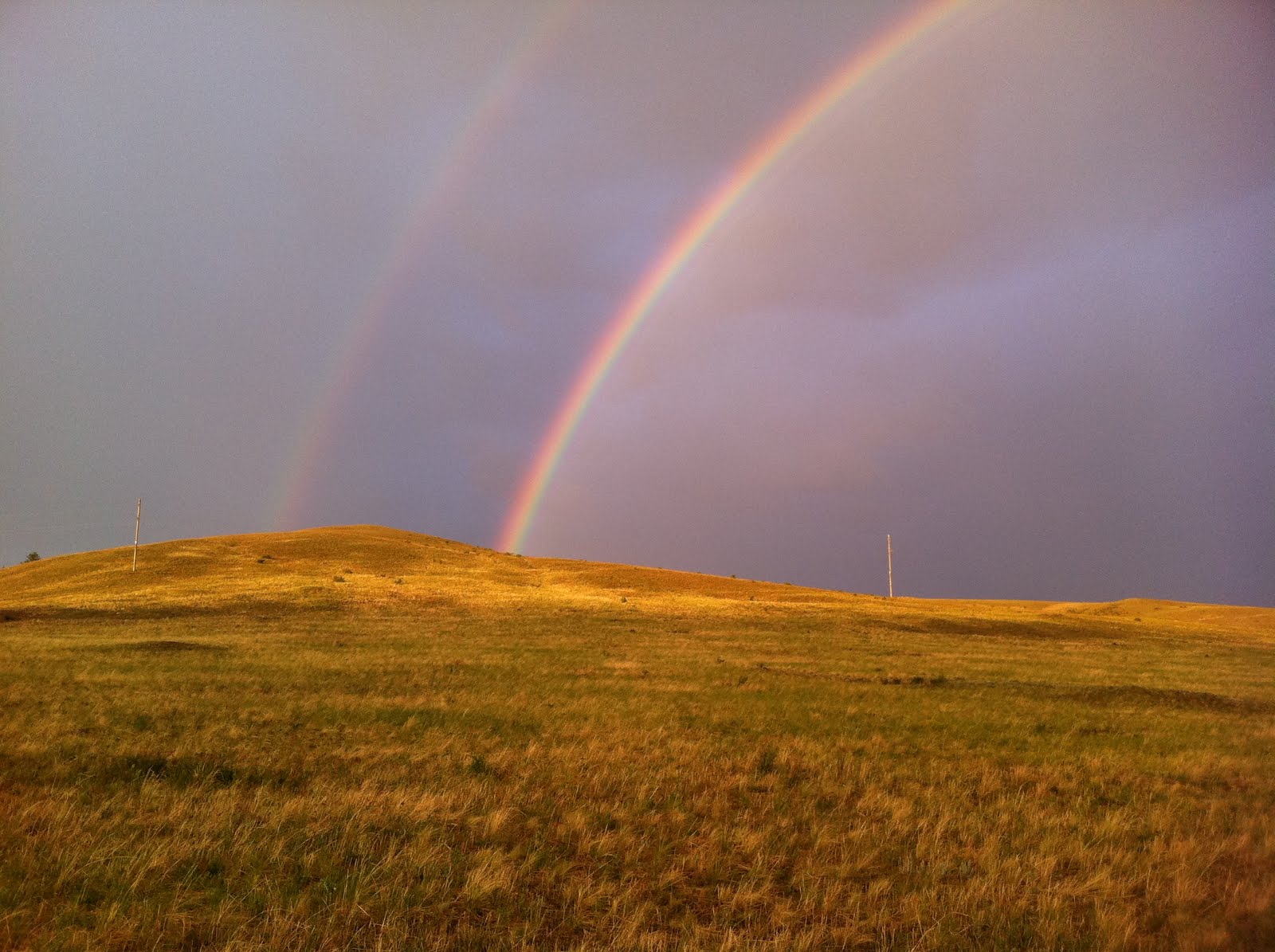
The next morning we awoke to the sound of raindrops on the ger!  The joy of the 7 of us sleeping inside was contagious and beautiful.  We prayed and then celebrated when God answered.  I was reminded that we don’t stop and do that nearly enough in our busy, scheduled and practical lives.  It continued to rain off and on the next fews days and late one afternoon we were blessed by an amazing complete double rainbow.  Our leader, Tsendee, said it quietly, simply and best:  God keeps His promises.

I’ve needed that reminder today.  As sometimes happens a “barrel of pastoral care concerns” overturned and I’ve found myself in conversations with individuals and families whose lives have been turned upside down.  As I’ve sat and listened and prayed with them I’ve been listening for the sound of raindrops, trusting that God does indeed keep His promises.

Tuesday, July 19, 2011

Mongolia - for all the joy!

I am one week back from my trip to Mongolia and still trying to find the right time zone and still processing an amazing journey.  I returned with both my head and heart filled with wonder at what God is doing.

In the coming days I’m going to attempt to post a few reflections on the trip (try in part because I’ve been such a reluctant blogger of late). 

Perhaps the most lasting impression (beside the taste of airagfermented mare’s milk) was the beautiful hearts of the V.E.T. NET staff.  I was humbled as I watched them care for some of the least of God’s children and inspirited by how boldly and naturally they shared the gospel.

On our last night in the countryside I chose a section from 1 Thessalonians as a final devotion together and as I return home this has become my prayer for our Mongolians ministry partners:

How can we thank God enough for you in return for all the joy we have in the presence of our God because of you?  Night and day we pray most earnestly that we may see you again and supply what is lacking in your faith.

Now may our God and Father Himself and our Lord Jesus clear the way for us to come to you. May the Lord make your love increase and overflow for each other and for everyone else, just as ours does for you.  May He strengthen your hearts so that you will be blameless and holy in the presence of our God and Father when our Lord Jesus comes with all His holy ones.

My journey to Mongolia was a witness to God answering that prayer as His love increases and overflows to touch hearts – even mine!

Tuesday, June 28, 2011

Advice

Last night a friend invited a group of men to j a dinner to celebrate his son’s 13th birthday.  Each of us was encouraged to share our experiences, wisdom and advice with his son as he continues the journey into manhood.  It was a fantastic evening and I suspect that those of us who received the invitation were blessed as much (if not more) than my friend and his son.

Here’s the advice and wisdom I shared with him – some of which comes from my dad to me.

1. Never buy cheap shoes.  Dad’s theory was that you spend a lot of your day on your feet so you want good shoes.

2. Never buy a cheap mattress.  Dad continued that you spent the rest of your day in bed so you want a good night’s sleep.

I added the following to Dad’s wisdom.

3. Whenever you get a chance to travel – travel.  We live in an amazing world and we should take every opportunity to go out and see it.   It doesn’t matter if you are sleeping on the floor or on a train – travel.  

4. Take more risks.  Study after study and life after life confirm that our deepest regrets are always the risks we didn’t take.  Ask out someone way out of your league.  Apply for a job way over your head.  Try out for a team you have no hope of making.  Run for an office you can’t win.  You never know what might happen.  The girl way out of my league said “yes” and “I do!”

5. Don’t wait.  Back in 1981 we traveled to the Orange Bowl to watch Clemson play Nebraska for the National Championship.  We were broke – so we slept of the floor at a hotel room provided for the band and I have no idea how we ate (I think by crashing tailgaters).  If we had waited until we could afford it to attend a National Championship Game for Clemson – we would still be waiting (though I have hope hopes based on our last couple of recruiting classes)!

6. Live generously.  More and more I am discovering that wealthy people don’t become generous.  Generous people become wealthy.  Start living generously with whatever you have now.

7. Make loving God and loving our neighbors more than just a phrase.  A life built on love is the only kind of life worth living and Jesus meant it when He promised that when we get loving God and loving our neighbors right everything else falls into place.

Monday, June 20, 2011

Tigger or Eeyore?

If you know Winnie the Pooh then you likely know the difference between Eeyore and Tigger.  Eeyore is pessimistic, depressed, and deflated. He has no self confidence and doesn’t think he does anything right. Tigger is energetic, joyful, enthusiastic, and positive.  For Tigger everyday is a new adventure filled with promise, potential, possibility and fun!

Eeyore’s favorite book of the Bible is Lamentations:

People have heard my groaning, 
   
but there is no one to comfort me.
Lamentations 1: 21

Tigger loves passages like those in Psalm 66:

Shout for joy to God, all the earth! 
 
Sing the glory of His name; 
   
make His praise glorious.

Come and see what God has done, 
   
His awesome deeds for mankind!
Psalm 66: 1, 2 and 5

What’s your approach to life?  Tigger or Eeyore?